
Allen Park City Directory Holdings
Allen Park directories live on many shelves. No single library holds everything. The strongest Allen Park lead is a combined Polk title covering Lincoln Park, Allen Park, and Melvindale, shown among the documented Downriver directory holdings. The Library of Michigan describes what these books preserve: addresses, household names, phone listings, business notices, and printed marks of ownership or occupancy. Arrangement shifts by year. Copy the title page, publisher, edition, and street section with every note. A regional volume can be a fine tool. Still, never trim its stated coverage to make it look like an Allen Park-only record, because the title page tells the truth about who was included.
| Collection | Years | Where held | Access route |
|---|---|---|---|
| Polk: Lincoln Park, Allen Park, Melvindale | 1967; 1971-77; 1979-82; 1984-85; 1987 | Genealogical-society holdings listing | Confirm edition, format, and use rules first |
| Polk Downriver and Western Wayne County | 1972-75; 1977-85; 1988-89; 1996-98 | Regional holdings | Use as labeled comparison coverage |
| Bressers Dearborn and Downriver | 1953; 1955-72; 1974-86; 1988-90; 1992-95; 2007-08 | Regional holdings | Check Allen Park pages in each volume |
| Library of Michigan directory collection | Varies by title | Second-floor South shelves and Microfilm Room | Print, call-order, microfilm, and institutional databases |
The combined Polk list has real holes. Missing years include 1968 through 1970, 1978, 1983, and 1986, and nothing after 1987 appears in that listing. Write each one down as a gap. Never fill a hole by guessing from the editions on either side. That invents a record. When the local list stops, try a regional Bressers or Polk volume, the Library of Michigan catalog, or a reference-desk question about MeLCat and microfilm. Log each route with its own title and date.
Allen Park City Directory Gaps
The combined Polk years tell a Downriver story, not a clean annual run. Begin with 1967 or a listed 1970s edition. Bridge a missing year with a Polk Downriver or Bressers title. But check its geographic heading first. A change between editions can mean a move, a dropped phone listing, or privacy. It can also mean a shift in the publisher's coverage. The entry itself never says which.
A careful record sheet is the real safeguard. Preserve the exact spelling, initials, suffix, and printed address. Add the directory title, year, page or section, nearby entries, and a confidence note. That discipline prevents a false merge of two people who share a name. It also makes a later library or archive visit repeatable.
Allen Park City Directory Shelf Access
The Allen Park Public Library sits at 8100 Allen Road. Its Allen Park Public Library hours and directions page is the practical local contact point. That is the place to start. The library's public material names no genealogy room and no complete directory run. So ask first. Request an exact title, microfilm availability, and MeLCat options at the reference desk before you drive over. MeLCat links more than 400 Michigan libraries. It can surface an out-of-area volume. A catalog hit is a lead rather than a confirmed Allen Park holding.
The local library is one channel among several. The Library of Michigan keeps print directories on second-floor South shelves, rare items by reading-room call order, and microfilm or fiche in the second-floor South Microfilm Room. Its catalog rewards a careful search. Try an ANSWER [city] city directory query when a local shelf lacks the edition you need. Institutional online routes exist too, through Ancestry Library Edition and HeritageQuest. Availability depends on the library or subscribing institution. No one should claim every directory is freely digitized. A catalog record is not a promise.
Note: Call ahead for an edition or microfilm item, because a holdings list does not prove current shelf availability.
Reading Allen Park City Directory Entries
An entry is a dated link. The Library of Michigan lists what these pages can hold: household members, street addresses, occupations, ownership or occupancy notation, business listings, phone numbers, and classified material. Fields vary by publisher. Meaning hides in small marks, so photograph or transcribe the abbreviation key before trusting any of them.
| Name as printed | Keep spelling, initials, suffixes, and punctuation exactly as shown. |
|---|---|
| Address and street section | Compare a house number across editions; the street section helps when the surname is unknown. |
| Household or phone clue | A phone listing often identifies only a head of household, not every person at the address. |
| Business or occupation line | Use it as a matching detail, then test it against an independent dated source. |
| Ownership or occupancy mark | Read it as the publisher's notation for that edition, not as a deed or proof of continuous presence. |
- Criss-cross directory
- A reverse section arranged by street and house number rather than surname.
- Householder index
- A name-oriented listing that may focus on the household contact rather than every occupant.
- Abbreviation key
- The volume's printed legend, which controls the meaning of its own symbols and shortened words.
Treat one entry as one dated observation. A street section often beats a surname search when the name is unknown. Still, it reflects the publisher's scope and choices. Scan the surrounding house numbers to separate two similar names, since neighbors and numbering give context a lone listing cannot. Keep the original entry intact. Convert nothing into present-day detail the printer never claimed.
Allen Park City Directory Checks
A directory lead gets stronger when a second source agrees on place and time. The Downriver Genealogical Society serves 18 southeast Wayne communities. Its Flat Rock research library offers word-searchable local newspapers. Digitized News-Herald weekend editions run from March 1987 through July 1990 and include the Allen Parker. A newspaper item adds a date or a family clue. It is a report, not a legal record.
The society's September 2024 publications list also describes Ballheim Funeral Home books. These record names, relatives, cemetery, residence, and related details. Pair a possible match with a vital, probate, cemetery, census, or recorded land source when access rules allow. The collections show what to request. They do not erase duplicate-name uncertainty.
Allen Park Directory History Labels
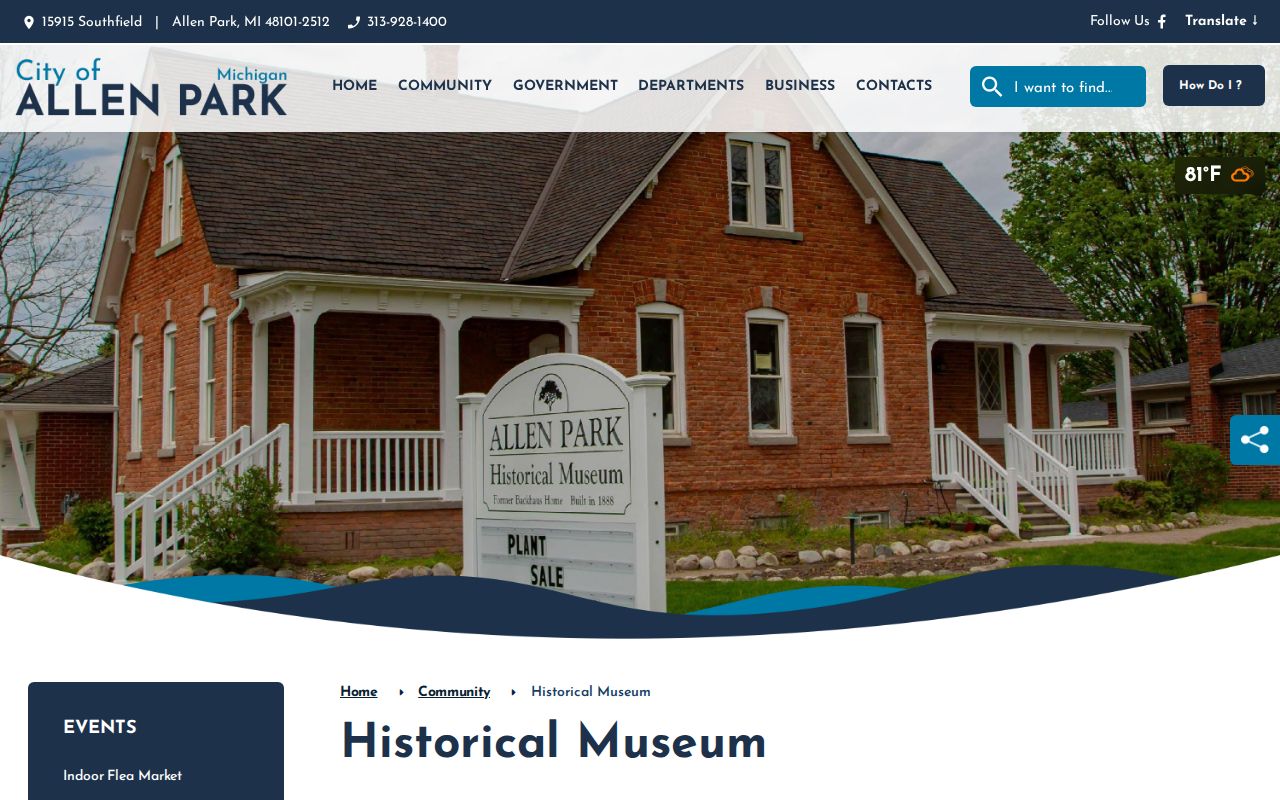
For Allen Park history, the Allen Park Historical Commission and Museum is the place to start. The commission publishes no item-level directory catalog. The museum sits at 15504 Englewood Avenue. It welcomes visitors Saturdays from 11 a.m. to 3 p.m. Call ahead at 313-928-1781. Ask a focused question about photographs, school material, subdivision maps, family files, or oral histories. Do not assume a name index exists.
Older listings may say Ecorse Township or name a neighboring community instead. Allen Park incorporated as a village in 1927 and became a city in 1957. Those labels are useful evidence of a source's date and geography. Preserve them in a research note. Then compare the location against current city and county maps.
| 1927 | Allen Park was established as a village, creating a useful break between township and village-era local records. |
|---|---|
| 1957 | Allen Park incorporated as a city, after which modern municipal departments became the local route. |
| 1987-1990 | News-Herald weekend editions in the Downriver digitization provide a dated newspaper window that includes the Allen Parker. |
Trace Allen Park City Directories
Build a household timeline from more than one Allen Park city directory edition. The federal census released so far reaches 1950. Later annual volumes can connect those decennial household snapshots without claiming uninterrupted residence. Keep the sequence honest. A directory shows an association in one edition. A deed names parties to a recorded instrument. A census captures a household at a moment in history.
- Normalize the street name and find the earliest listed name or address in a confirmed edition.
- Copy the title, year, page or street section, printed name, and exact address.
- Check the next available local or regional edition, marking a gap when the listed run skips a year.
- Use the street section to compare nearby numbers, then pair an appropriate decade with the released census.
- Test a change with a newspaper, probate, vital, assessor, or deed source that fits the date and question.
A name dropping out of a listing has several possible explanations. The person may have moved. They may have died, changed a phone listing, or been omitted. Some fell outside a shifted coverage area. Keep those explanations separate until an independent record settles the question. For a modern address-keyed sequence, turn to the Allen Park street directory. Do not ask a historical volume to answer a current parcel question.
Allen Park Directory Source Limits
Historical directories work best when their limits stay visible. Allen Park publishes no official online historical resident index. It offers no obituary index and no museum name database. The last listed local edition is the 1987 Polk volume. For earlier or later material, rely on the library, the museum, the historical society, and county archives. A narrow Michigan Freedom of Information Act request also helps when a city-held record exists. Protect private details. Treat a past address as a dated record, not a present-location claim. Michigan's Address Confidentiality Program gives eligible participants a designated address. A result that is absent, redacted, or ambiguous should stay that way. Log the dead ends too. For a missing edition or a name that cannot be separated from another person, preserve the search term, repository, title, format, and negative result. The Archives of Michigan Wayne County guide points to original court, probate, naturalization, tax, voter, and military series. Check those series before any Lansing contact. That targeted step beats broadening a name search until the record loses its Allen Park connection. Cite each record by its own date and geographic title. A Downriver directory, a township-era item, and a modern city record can all bear on Allen Park. They are not the same kind of evidence, though. Holding that distinction keeps a family-history trail useful when a repository has a gap, a catalog offers only a lead, or an online result lacks the source details verification demands.